Your retainer is shedding microplastics into you every night.
Warm, wet and chewed on for eight hours a night, one plastic retainer shed about 59,000 microplastics in six months in our University at Buffalo study.1 moses makes the same custom-fit retainer from PHA, with no petroleum plastic.
Make The Clean Switch- 30-day fit guarantee
- Free shipping
- HSA / FSA eligible
We couldn’t open the quiz. Please reload and try again.


How many microplastics come off your retainer?
We ran plastic retainers through a chewing simulator at the University at Buffalo. Each pair shed about 59,000 microplastics for 6 months of wear. That’s roughly 118,000 a year, about double the microplastics the average American eats and breathes.1, 2
Make The Clean Switch
Microplastics are no longer a maybe.
Already inside us
Microplastics have been found in human blood, lungs, placentas, brains and breast milk. Every human tissue tested so far has come back contaminated.
Higher where there’s disease
Tissue from people with IBD, dementia and heart disease holds significantly more microplastics than healthy tissue.
Rising every year
Microplastics in human brain tissue rose about 50% in eight years. What we take in today stays with us for decades.17
Don’t wait for regulators
We waited on lead, asbestos and PFAS. Start with the microplastics you put in your mouth every night.

Same fit. No microplastics left behind.
The Unplastic Retainer is made from pure PHA, a material microbes grow from sugar. It’s custom-fit from your dental scan and holds your teeth like the retainer you wear now. When it wears, it breaks down into a molecule your body already makes, instead of persisting as microplastics.
- Designed to avoid persistent microplastic shedding
- Material tested at body temperature (37°C)
- Microbe-grown, no petrochemicals
- Custom-fit from your dental scan
- No added plasticizers, colorants or stabilizers
- Third-party screened for contaminants
Before you make the switch.
Every retainer comes with a 30-day fit guarantee. If it isn’t right, we’ll remake it at no charge.
Why does it cost more than a plastic retainer?
Our PHA material costs 100× more than PETG. We hope to bring the cost down over time.
I don’t have a scan. Do I need to see a dentist?
Already have a scan? Our concierge team will retrieve it from your current provider. If not, we’ll arrange a scan at a clinic near you and cover the cost.
Wait, it breaks down? Will it fall apart in my mouth?
No. It keeps its shape and holding force through normal wear. It’s designed to be replaced every six months, like a toothbrush, so what wears off doesn’t linger in your body as microplastics. The subscription plan sends your next pair before the old one wears out.
Why isn’t it crystal clear?
Crystal-clear plastic needs chemical clarifiers and stabilizers. We leave them out. The slight haze is the material in its natural state.
Should I stop wearing my current retainer?
No. Keep wearing it until your moses pair arrives. Your teeth will shift without one.
When will my retainer arrive?
Timing depends on when we receive a usable scan and can begin making your retainer. Once we receive your scan, we’ll ship your retainer within 5 business days. For an update on your order, email ask@moses.com.
Can I cancel my order or get a refund?
Email ask@moses.com with your order details. We’ll check the status of your order and explain the cancellation or refund options available.
Stop eating plastic
Make The Clean Switch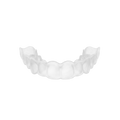
Sources
- Westlie, A. H. Microplastic release from orthodontic retainers during simulated wear. moses white paper, 2026. Lab simulation, not a human study; the per-year figure is a linear extrapolation.
- Cox, K. D. et al. Human consumption of microplastics. Environ. Sci. Technol. 2019 (corrected 2020). doi
- Warunek, J. et al. Orthodontic-derived microplastics impact macrophage differentiation and homeostasis. Prog. Orthod. 2026. doi
- Hussain, K. A. et al. Release of micro- and nanoplastics from plastic containers. Environ. Sci. Technol. 2023. doi
- Snekkevik, V. K. et al. Sources of microplastic contamination in home kitchens. Heliyon 2024. doi
- Tang, K. H. D. Counteracting the harms of microplastics on humans. Microplastics 2025. doi
- Marfella, R. et al. Microplastics and nanoplastics in atheromas and cardiovascular events. N. Engl. J. Med. 2024. An association, not proof of cause. doi
- Nihart, A. J. et al. Bioaccumulation of microplastics in decedent human brains. Nat. Med. 2025. Its measurement methods have been debated. doi
- Barile, C. et al. Damage and microplastic release during cyclic loading of clear aligners. PLoS One 2025. doi
- Independent contaminant screening by Light Labs, batch RMPHA26001B1. Full results and raw lab reports.
- Leslie, H. A. et al. Discovery and quantification of plastic particle pollution in human blood. Environ. Int. 2022. PubMed
- Jenner, L. C. et al. Detection of microplastics in human lung tissue. Sci. Total Environ. 2022. PubMed
- Ragusa, A. et al. Plasticenta: first evidence of microplastics in human placenta. Environ. Int. 2021. PubMed
- Human brain tissue microplastics and nanoplastics study, 2024. PubMed
- Ragusa, A. et al. Raman microspectroscopy detection of microplastics in human breastmilk. Polymers 2022. MDPI
- Yan, Z. et al. Analysis of microplastics in human feces and patients with inflammatory bowel disease. Environ. Sci. Technol. 2022. PubMed
- Nihart, A. J. et al. Bioaccumulation of microplastics in decedent human brains. Nat. Med. 2025. PubMed
- Gut inflammation in mice exposed to microplastics. 2024. PubMed
- Hormone disruption in mice exposed to microplastics. Part. Fibre Toxicol. 2022. Article
- Reproductive effects of microplastics in mice. 2022. PubMed
- Developmental effects of microplastics in mice. Front. Physiol. 2023. Article
- Organ damage in mice exposed to microplastics. Sci. Total Environ. 2021. Article
- Mouse studies use higher doses than typical human exposure; results in animals don’t prove the same effects in people.
This page is for information only and isn’t medical advice. Keep wearing your retainer as prescribed, and talk to your dentist or orthodontist with any questions.